This week I finished Starship Troopers by Robert Heinlein. While I appreciate the book for what it is and how it has influenced the genre throughout the years, I found that the book still suffered from many of the problems I had with Stranger in a Strange Land.

While I don’t feel like this book was as preachy as Stranger, it still suffered from Heinlein’s habit of stopping the action and explaining his various viewpoints. Heinlein uses the recurring character Lieutenant Colonel Jean V. Dubois as his vehicle for explaining his viewpoints. Because Dubois is a retired officer working as a teacher, Heinlein is able to lecture to the reader through the varying class discussions. The problem is this gets more tedious as the book goes on. It may not have been as often as in Stranger, but the content of this book is generally fast paced military science fiction and thus the multi-page sermons are even more jarring. It doesn’t benefit the story and actually removes readers from the plot.
The ideas are expressed poorly, but that doesn’t make them uninteresting. Heinlein makes his case throughout the story for a limited democracy, a society that will only give you the opportunity to vote if you prove that you have a sense of moral responsibility by putting the group over the individual. You prove that through two years of service in the Terran Military. It’s an interesting idea that would probably never work in reality, but it’s fascinating nonetheless. The book also criticizes the political structure of the time as being rather quixotic. People of the “failed civilizations” would vote for anything that would benefit them, without enduring any of the consequences. Heinlein goes so far as to criticize the Declaration of Independence, stating that the pursuit of happiness is our only right and that life and liberty must be fought for.

Starship Troopers is an interesting book that suffers not from its’ ideas but from its’ presentation. Heinlein wants to make his ideas as clear as possible so that no reader doubts where he stands. The problem is reading an essay within fiction is not the ideal reading experience. Still, as it is a short read, I recommend it to fans of science fiction who want to read the story that lead to the popularization of military sci-fi and created many more of the universal conventions of the genre. In fact, though I didn’t realize it at the time, my novel The Amalgam would never have been possible without Heinlein. His ideas have so thoroughly permeated the genre that I was influenced without ever knowing the source.
I also finished the second season of Orphan Black and the last two episodes of the season really brought me back. After an all-around great first season, the second season sort of stalled in the beginning. The story was growing more convoluted and erratic, jumping from character to character before giving us a chance to learn too much. There were some cool scenes in the first few episodes, but they were marred by the story’s multi-branching path and overall inconsistent presentation. After stumbling through the first few episodes, the show finds its’ stride once more and returns to the fantastic science fiction story we saw in the first season. By the end you’ll have more questions than answers, but you’ll still come away satisfied at the close of the season.
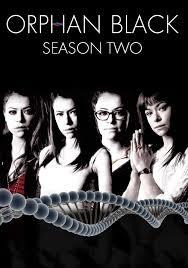
Helena has easily become one of the most interesting characters in the show. While Sarah Manning is still the central character, this season she took more of a back seat and allowed the rest of the characters to grow. I really enjoyed seeing Cosima and her personality continuing to shine even through her battle with a terminal illness. Alison even began to grow on me as she battled addiction, guilt, and the lies that her marriage was built on. Tatiana Maslany’s skills as an actress cannot be overstated. She’s brilliant and perfectly embodies so many individual and unique characters. Plus there’s a clone dance party and what could be better than that?

As a whole, it’s more of what made the first season so interesting. Taken in parts, the season starts off rather poorly but has redeemed itself by the end. I’d say if you really liked the first season try and make it through the rough patches of the beginning. If you weren’t already invested I’d recommend passing on this one.
So that was my week in science fiction. If you want to tell me why a limited democracy is a great idea or gush over Helena and/or Tatiana Maslany, feel free to message me or tweet me @left4turtle.
 Agustin Guerrero
I agree about how very interesting Helena has become in the second season. I hated her in the first season but she has been a joy to watch this time. First I thought, well, she’s not so bad after all and then I came to actually like her a lot.
Where Season Two bogged down for me was at the farm. I so hated Henrik and almost everything about that place that it spoiled my enjoyment of any episode with too much focus on it. Glad when Helena burned it down. Go, Helena!
Throughout the first season I thought she was still an interesting character even if she was portrayed as a villain. Her redemption arc throughout the second season made the show for me. When she fell in love with Jesse might have been one of my favorite scenes. And I agree I kind of wish that whole subplot of the farm was gone. I think we were all wishing for Helena to take her revenge!
“While I don’t feel like this book was as preachy as Stranger” — yes, because he wrote this one earlier and for a different subgenre of SF (with different requirements) — the juvenile. Of course, his editors thought it was too dark so it wasn’t marketed as one.
But yes, I find his unabashed jingoism rather hard to bare sometimes…
I think it’s interesting that Heinlein intended Starship Troopers for a younger audience. The history of Heinlein’s work and the man himself fascinate me. However, my issue with Stranger was the bluntness with which he conveys his viewpoints. Reading a lecture isn’t what I want in my science fiction. This book shares that problem, regardless of intended audience or genre, albeit to a lesser extent. I think in many ways that makes Starship Troopers a more enjoyable book.
And I agree it can be grating after awhile. I try to see it as partly a product of the time.
I enjoy social SF with such ruminations… But yes, they can be conveyed in a more artful way. But, I find Heinlein to be the most overrated of the so-called “greats.”
I agree that a social commentary is almost a necessity for a great work of science fiction. Heinlein’s ideas are more sound than his execution. I’m relatively new to classic science fiction. From what I’ve read of Heinlein I’m inclined to agree with you. I checked out your blog along with your top rated books and most I’ve never heard of. I’m excited to add a few to my reading list. I noticed that your all-time favorites weren’t listed. Would you mind sharing some of your all-time favorites?
Realize that I enjoy more radical/experimental/literary SF from the 50s-70s… Not most space opera/pulp/hard SF.
I haven’t really put together a best of list. The rating listing is only from the lifespan of my blog.
I have a few more standard favorites which I haven’t written reviews for.
Le Guin: The Left Hand of Darkness
Philip K. Dick: Martian Time-Slip, Ubik
Stanislaw Lem: Cyberiad, Solaris
etc.
I’m trying to broaden my SF scope and read as much as I can from the various subgenres. I really appreciate you sharing these. Most of the lists I look to for guidance have the same top books (Stranger in a Strange Land, Dune, Ender’s Game, etc.) but your books are new to me. Ubik sounds especially interesting. Thanks again and I look forward to reading more from your blog.
No problem. Thanks!